Modular Construction Market to Grow from USD 90.02 Billion in 2026 to USD 158.38 Billion by 2035 at 6.48% CAGR
Asia-Pacific accounted for 43.9% of global revenue in 2025 CA, UNITED STATES, September 2, 2026 /EINPresswire.com/ --
Press Release Disclaimer: This is a press release distributed through the XPR Media network. It has not been independently verified by our newsroom.

Asia-Pacific accounted for 43.9% of global revenue in 2025
CA, UNITED STATES, September 2, 2026 /EINPresswire.com/ — The Modular Construction Market is transforming the building industry by shifting a growing portion of construction activity from conventional job sites to controlled factory environments. Rising labor costs, skilled-worker shortages, housing requirements, sustainability targets, and demand for faster project completion are encouraging developers to adopt modular building methods.
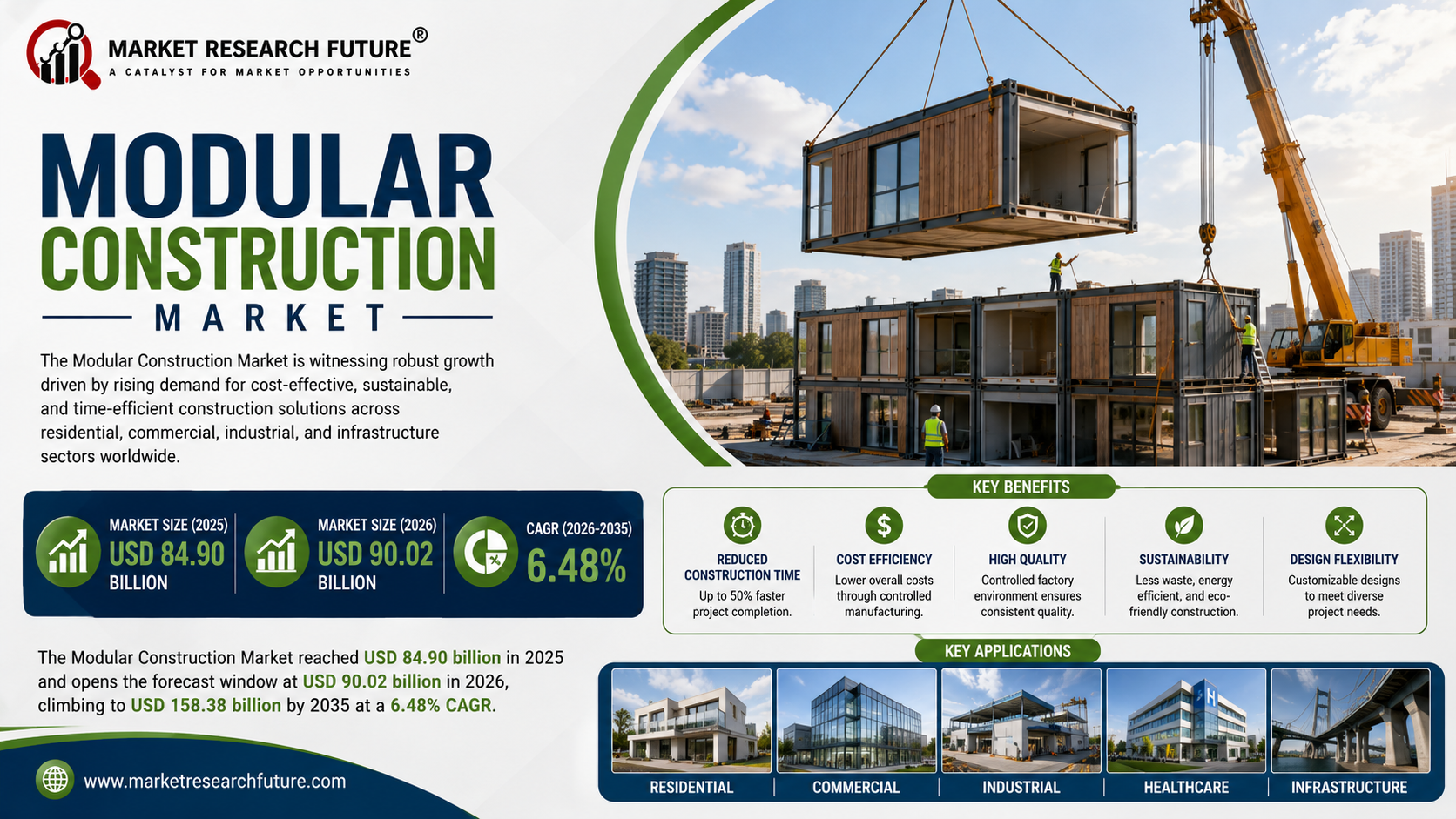
According to Market Research Future, the global Modular Construction Market reached USD 84.90 billion in 2025 and is projected to rise to USD 158.38 billion by 2035, registering a 6.48% CAGR from 2026 to 2035. The market is expected to reach approximately USD 90.02 billion in 2026, establishing a strong growth trajectory over the forecast period.
Off-Site Construction Gains Momentum
Modular construction involves manufacturing building components or complete modules in controlled factory environments before transporting them to the final construction site. This approach enables manufacturers to conduct multiple activities simultaneously rather than depending entirely on sequential on-site construction.
Factory production can improve quality control, reduce material waste, and provide greater predictability in project schedules. As construction companies face increasing pressure to deliver projects quickly, modular methods are becoming an attractive alternative to conventional construction.
The growing adoption of Building Information Modeling, automation, robotics, and digital design platforms is further improving the efficiency of modular production.
Skilled Labor Shortages Support Market Expansion
A shortage of skilled construction workers is one of the most important factors driving modular construction adoption. Traditional construction depends heavily on skilled tradespeople working at project sites, while factory-based production can standardize many activities and reduce the number of workers required on-site.
Labor shortages are particularly significant in North America, Europe, and Japan. Wage inflation is also encouraging contractors to identify methods that can improve productivity without proportionally increasing labor requirements.
Factory-based construction enables companies to organize production lines, automate repetitive processes, and create specialized workstations. These advantages can help construction companies manage labor constraints while maintaining output.
Download Report Sample Copy: https://www.marketresearchfuture.com/sample_request/1682
Affordable Housing Creates Significant Opportunities
The global shortage of affordable housing is creating major opportunities for modular construction. Factory-produced modules can potentially shorten construction timelines and support large-volume housing programs.
Emerging economies are particularly attractive because rapid urbanization is increasing demand for residential buildings. Governments are increasingly considering prefabrication and off-site construction as part of affordable housing strategies.
India, Indonesia, Nigeria, and Egypt are among the markets where large housing requirements could create opportunities for modular building systems. Local manufacturing partnerships can also reduce transportation costs and make modular solutions more economically viable.
Residential Applications Show Strong Growth
Residential construction is one of the most promising end-user sectors. The residential segment is projected to expand at an 8.41% CAGR through 2035, making it the fastest-growing end-user sector in the market.
Modular homes can be produced using standardized designs while still allowing customization according to local requirements. Developers can use factory production to improve construction scheduling and potentially reduce delays caused by adverse weather or site conditions.
The increasing demand for affordable housing, urban apartments, student accommodation, and workforce housing is expected to support continued adoption.
Industrial and Institutional Construction Leads
Industrial and institutional applications accounted for approximately 39.8% of the Modular Construction Market in 2025, making this the leading end-user sector. Data centers, laboratories, schools, healthcare facilities, and other institutional projects are increasingly adopting modular approaches.
These projects often require predictable schedules and consistent quality. Factory manufacturing can support repeatable designs and standardized components, making modular construction suitable for facilities that need to be delivered within strict timelines.
The expansion of healthcare and educational infrastructure is expected to provide additional opportunities.
Data Centers Become an Attractive Application
The rapid expansion of cloud computing, artificial intelligence, and digital services is increasing global demand for data centers. Modular construction can help data-center developers address the need for rapid capacity deployment.
Prefabricated electrical rooms, cooling systems, power infrastructure, and modular data halls can be manufactured and tested before reaching the project site.
The growing demand for computing capacity is therefore creating a high-value opportunity for modular construction companies. The ability to standardize components across multiple locations can also support repeat business with large data-center operators.
Buy Now Copy: https://www.marketresearchfuture.com/checkout?currency=one_user-USD&report_id=1682
Steel Remains the Dominant Material
Steel is the leading material category in the Modular Construction Market, accounting for approximately 78.0% of market share in 2025. Automated welding, standardized connection systems, and the structural strength of steel support its widespread use in modular buildings.
Steel modules can be manufactured with high dimensional consistency and transported to construction sites for rapid assembly.
Timber and mass timber are also gaining attention. The timber category is projected to expand at a 7.35% CAGR through 2035, supported by increasing interest in lower-embodied-carbon construction and sustainable building materials.
Permanent Modular Construction Maintains Importance
Permanent modular construction is increasingly being used for buildings intended to remain at their final locations. Residential buildings, schools, healthcare facilities, commercial structures, and institutional projects can all incorporate permanent modular systems.
Relocatable modular construction is also gaining momentum, particularly for temporary classrooms, workforce accommodation, healthcare facilities, offices, and emergency housing.
Relocatable configurations are projected to grow at a 7.86% CAGR, supported by leasing models and the increasing demand for flexible space.
Government Policies Encourage Prefabrication
Government policies and public procurement programs are becoming important drivers of modular construction. Some governments are establishing prefabrication targets or encouraging off-site construction for public projects.
China’s construction policies have promoted off-site methods in designated areas, while Singapore has introduced requirements supporting Design for Manufacturing and Assembly.
These initiatives can transform modular construction from an optional technology into an increasingly standardized part of public infrastructure and housing procurement.
Sustainability Strengthens Modular Construction Adoption
Environmental considerations are becoming increasingly important in construction. Modular manufacturing can reduce material waste through controlled production and optimized cutting processes.
Factory production also allows greater control over material usage, recycling, and energy consumption. MRFR notes that factory fabrication can reduce material waste compared with conventional site-built construction.
The growing emphasis on embodied carbon, green building standards, and whole-life environmental performance is therefore supporting interest in modular construction.
Timber and mass-timber modules are particularly attractive in markets where developers are seeking lower-carbon building solutions.
Digital Technologies Transform Modular Building
Technology is becoming an essential component of modern modular construction. Building Information Modeling enables designers, engineers, manufacturers, and contractors to coordinate projects before production begins.
Artificial intelligence can support design optimization, scheduling, quality inspection, and predictive maintenance. Robotics can automate welding, cutting, and assembly operations.
Machine-vision systems can also identify dimensional deviations before modules leave the factory, reducing rework and improving quality consistency.
These technologies are expected to become increasingly widespread as modular construction factories move toward highly automated production environments.
Transportation Constraints Remain a Challenge
Despite its advantages, modular construction faces logistical limitations. Large modules must be transported from manufacturing facilities to construction sites, and road infrastructure can restrict module dimensions.
Oversized transportation can require special permits, escorts, and route planning. Transportation costs can increase significantly when modules must travel long distances.
As a result, the market is increasingly moving toward regional manufacturing networks rather than relying on a single centralized factory serving a large geographic area.
Developing smaller regional plants can reduce transportation requirements and allow manufacturers to respond more efficiently to local demand.
Report Summary: https://www.marketresearchfuture.com/reports/modular-construction-market-1682
Factory Investment Creates Entry Barriers
Modular construction requires significant investment in manufacturing facilities, equipment, technology, workforce training, and supply-chain infrastructure.
Factory utilization is therefore a critical factor in profitability. If order volumes are inconsistent, manufacturers may struggle to achieve sufficient production utilization to cover fixed costs.
Companies are responding by diversifying their customer bases, adopting standardized modules, developing leasing models, and pursuing long-term contracts.
The ability to maintain consistent factory utilization will remain an important competitive factor as the industry expands.
Asia-Pacific Leads Global Growth
Asia-Pacific accounted for approximately 43.9% of global Modular Construction Market revenue in 2025 and is also the fastest-growing major region, with a projected 7.72% CAGR through 2035.
Rapid urbanization, housing demand, infrastructure investment, and government support for prefabrication are contributing to regional growth.
China and India are particularly important markets because of their large populations and extensive housing and infrastructure requirements.
The region is also increasingly integrating modular construction with sustainable building technologies, digital design, and factory automation.
North America Benefits from Data Centers and Healthcare
North America represented approximately 24.6% of the global market, with the region generating around USD 20.89 billion in 2025.
The region’s mature construction industry, labor shortages, healthcare infrastructure requirements, and rapid data-center development are supporting demand.
The use of modular systems for hospitals, schools, commercial buildings, workforce accommodation, and data centers is expected to expand as developers seek faster and more predictable construction.
Europe Focuses on Low-Carbon Construction
Europe accounted for approximately 22.1% of the Modular Construction Market in 2025. Environmental regulations, energy-efficiency requirements, and embodied-carbon policies are encouraging developers to evaluate factory-based construction methods.
Modular construction can support European sustainability objectives through improved material efficiency, controlled production, and increased use of timber and other lower-carbon materials.
The renovation and expansion of existing buildings also create opportunities for lightweight modular extensions and rooftop additions.
Middle East and Africa Offer Emerging Opportunities
The Middle East and Africa region is expected to deliver strong growth, with a projected 7.94% CAGR, making it the second-fastest-growing regional market.
Large-scale urban developments, tourism projects, workforce housing, infrastructure programs, and healthcare investments are creating opportunities for modular construction.
The ability to rapidly deploy buildings is particularly attractive for large development programs where conventional construction may require longer timelines.
Competitive Landscape
The Modular Construction Market includes major companies such as Sekisui House, WillScot Holdings, Daiwa House Industry, Modulaire Group, Skanska, and Fluor Corporation.
Competition is increasingly focused on factory automation, standardized designs, digital workflows, sustainable materials, transportation efficiency, and project execution capabilities.
Companies are also expanding their manufacturing footprints and developing partnerships with developers, governments, and infrastructure operators.
Leasing and space-as-a-service models are becoming another competitive strategy, particularly for relocatable modular buildings. These models can generate recurring revenue while giving customers greater flexibility.
Related Report
Construction Stone Market https://www.marketresearchfuture.com/reports/construction-stone-market-3894
Pipeline Construction Market https://www.marketresearchfuture.com/reports/pipeline-construction-market-12191
Construction Equipment Market https://www.marketresearchfuture.com/reports/construction-equipment-market-1963
Construction Lasers Market https://www.marketresearchfuture.com/reports/construction-lasers-market-6481
Dry Construction Market https://www.marketresearchfuture.com/reports/dry-construction-market-2846
Reconstruction Solution Market https://www.marketresearchfuture.com/reports/reconstruction-solution-market-12534
Construction Fasteners Market https://www.marketresearchfuture.com/reports/construction-fasteners-market-12630
Market Research Future
Market Research Future
+ +1 855-661-4441
email us here
Legal Disclaimer:
EIN Presswire provides this news content “as is” without warranty of any kind. We do not accept any responsibility or liability
for the accuracy, content, images, videos, licenses, completeness, legality, or reliability of the information contained in this
article. If you have any complaints or copyright issues related to this article, kindly contact the author above.

Media gallery