When Cooling and Clean Air Both Depend on Power: A Grants Pass Backup Plan
A three-stage household plan can clarify when to ventilate, when to recirculate, and when to leave for a cleaner,
Press Release Disclaimer: This is a press release distributed through the XPR Media network. It has not been independently verified by our newsroom.
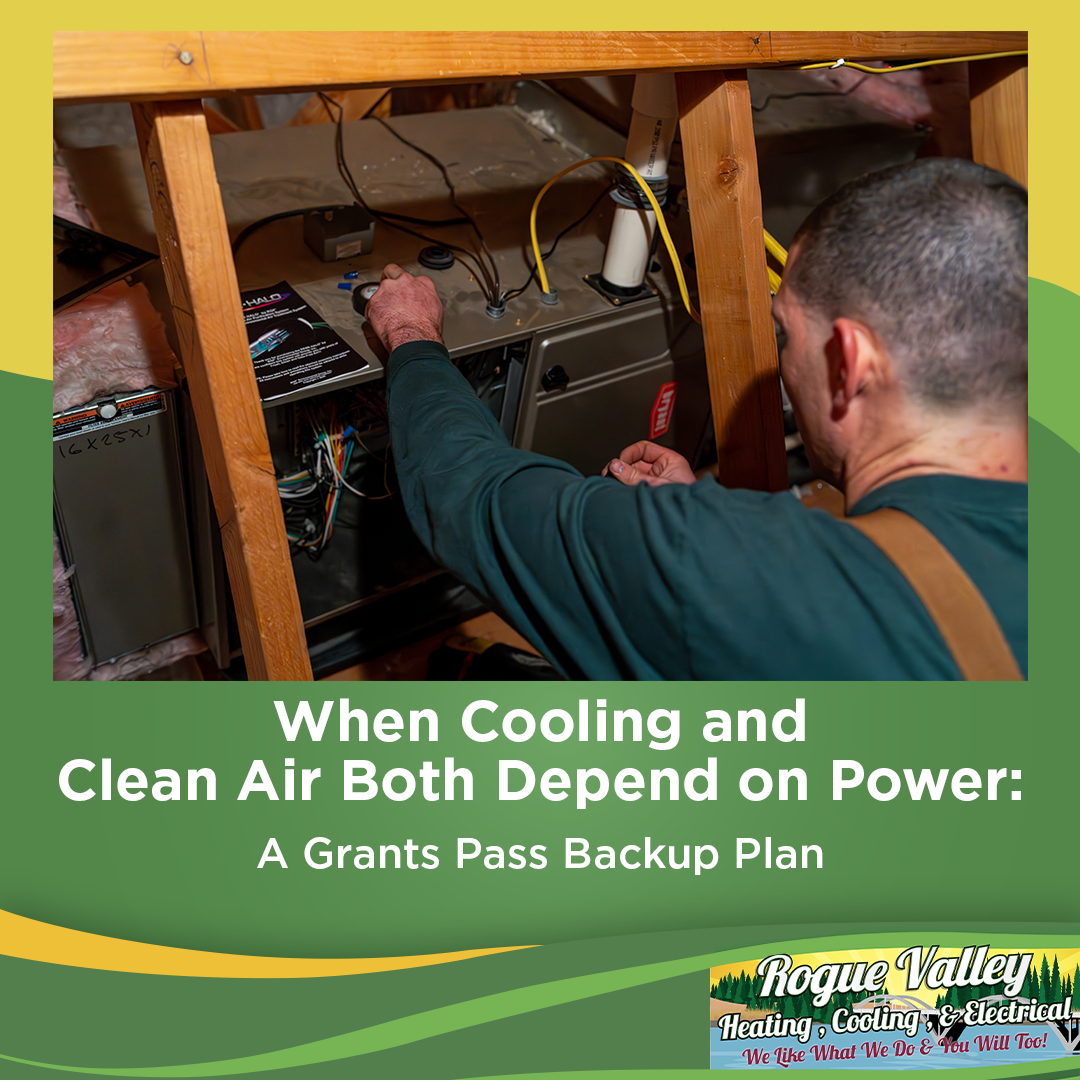

A three-stage household plan can clarify when to ventilate, when to recirculate, and when to leave for a cleaner, cooler location.
GRANTS PASS, OR, UNITED STATES, September 10, 2026 /EINPresswire.com/ — The City of Grants Pass displayed an EXTREME fire-danger level on Sept. 2 and directed residents to current air-quality, fire and evacuation resources. That status does not predict that a particular home will lose power or receive smoke, but it makes a two-part backup question timely: What happens if open windows are not safe and powered cooling is unavailable?
The answer should be decided before conditions change. A practical plan can be organized around three states, each with a different priority.
State 1: Power is available, and outdoor air is acceptable
When local air-quality information shows that outdoor air is suitable and the outdoor temperature is lower than indoors, ventilation may help release heat. Residents should use current conditions rather than assuming that a clear-looking sky means the air is clean.
This is the planning stage. Save local alert and utility contacts, identify an alternate location with air conditioning, determine how household members and pets would get there, and prepare a way to charge phones. People who rely on powered medical equipment should follow their provider’s and utility’s planning guidance.
The AC system can also be observed under normal conditions. Confirm that it starts, moves air, and maintains the household’s normal safe setting. A known equipment problem is easier to address before it becomes part of an emergency.
State 2: Smoke is present, but power remains available
EPA guidance says windows and doors should be closed when smoke conditions call for keeping outdoor air out. Central air conditioning can support indoor temperature control; if the system has an outdoor-air setting, EPA advises closing the intake or using recirculation during wildfire smoke.
A compatible higher-efficiency filter can help reduce smoke particles, but the system must be able to handle it. Homeowners should not force a filter into the wrong slot or assume that the highest number on a package is automatically safe for every blower.
A cleaner-air room works only while the home remains safe and cool enough to occupy. Residents must remain prepared to evacuate and follow local authorities if instructions change.
State 3: Smoke or unsafe heat is present and power is out
This is where the backup destination becomes more important than the equipment. EPA says that if a household cannot stay cool, electricity is out, or too much smoke is entering, seeking shelter elsewhere may be best. The destination might be an unaffected friend or relative, an official cleaner-air shelter, or another public building identified by authorities.
A cooling contractor cannot restore grid power or determine whether it is safe to remain in an evacuation area. Emergency alerts, evacuation orders, and public-health instructions take priority over HVAC advice.
If a household uses a portable generator, FEMA directs that it be operated outdoors at least 20 feet from windows, doors, and attached garages. Manufacturer instructions and official safety guidance should be followed; a generator must never be operated indoors.
Routine AC installation and replacement planning can include a discussion of normal system operation during smoky conditions, but no cooling system eliminates the need for an outage plan.
Households that want the cooling system checked during normal conditions may be eligible for Rogue Valley’s $99 Heating/Cooling Tune-Up.
Rogue Valley Heating, Cooling & Electrical provides air conditioning services for Grants Pass homeowners who want to address a normal equipment concern before an emergency. To request service, call 541-204-0966.
About Rogue Valley Heating, Cooling & Electrical
Rogue Valley Heating, Cooling & Electrical serves Grants Pass and surrounding Rogue Valley communities with residential air-conditioning repair, maintenance, installation, and replacement services.
Grants Pass AC Team
Rogue Valley Heating, Cooling & Electrical
+1 541-204-0966
email us here
Visit us on social media:
Facebook
Instagram
LinkedIn
Legal Disclaimer:
EIN Presswire provides this news content “as is” without warranty of any kind. We do not accept any responsibility or liability
for the accuracy, content, images, videos, licenses, completeness, legality, or reliability of the information contained in this
article. If you have any complaints or copyright issues related to this article, kindly contact the author above.

Media gallery